

Specifications
Surface Treatments
Certifications
- ISO 9001 - 2015 Certified
- PED 2014/68/EC
- NACE MR0175/ISO 15156-2
- NORSOK M-650
- DFAR
- MERKBLATT AD 2000 W2/W7/W10
A286 flat bar is rectangular-cross-section A286 bar stock used for structural members, machined brackets, support frames, and applications where rectangular geometry is preferred over round or square. TorqBolt manufactures A286 flat bar to AMS 5731, AMS 5732, ASTM A453 grade 660, and ASTM B637 standards in widths 10-200 mm and thicknesses 3-50 mm. Hot-rolled or cold-drawn finishes; ±0.20-0.50 mm tolerance on width, ±0.10-0.30 mm on thickness. Heat-treated to deliver 130 ksi tensile / 95 ksi yield, retained mechanical properties at 700 °C continuous service. Distinguished from A286 plate by the elongated rectangular cross-section (length ≫ width) vs plate (width ≈ length). See parent A286 bar stock, sister variants round bar, hex bar, square bar, and the canonical chemical composition, mechanical properties.
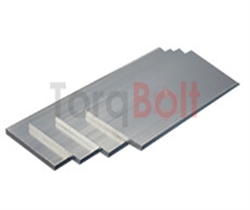
A286 flat bar is produced by hot-rolling A286 ingot through a flat-pass roll mill, or by cold-drawing hot-rolled bar through a flat die for tighter tolerance. The width-to-thickness ratio typically ranges from 2:1 to 10:1; aspect ratios above 10:1 transition to A286 plate classification. Used as raw stock for aerospace machined brackets, mounting plates, structural reinforcement straps, electrical bus-bar applications (where non-magnetic A286 prevents EMI in high-current bus-bar), and gas-turbine combustor support frames. Each lot is solution-treated and aged per AMS 5732, surface-pickled, and ships with EN 10204 3.1 mill cert.
TorqBolt produces A286 flat bar in five primary cross-section ranges:
| Thickness × Width | Hot-rolled tol. (W × T) | Cold-drawn tol. (W × T) | Standard length | Available specs |
|---|---|---|---|---|
| 3 × 10 mm | ±0.30 × ±0.20 | ±0.20 × ±0.10 | 3-6 m | AMS 5731 / 5732 |
| 6 × 25 mm | ±0.30 × ±0.20 | ±0.20 × ±0.10 | 3-6 m | AMS 5731 / 5732 |
| 10 × 40 mm | ±0.30 × ±0.20 | ±0.20 × ±0.13 | 3-6 m | AMS 5731 / 5732 |
| 16 × 60 mm | ±0.40 × ±0.25 | ±0.25 × ±0.15 | 3-6 m | AMS 5731 / 5732 |
| 20 × 80 mm | ±0.50 × ±0.30 | ±0.30 × ±0.18 | 3-6 m | AMS 5731 / 5732 |
| 25 × 100 mm | ±0.50 × ±0.30 | ±0.30 × ±0.20 | 3 m | AMS 5731 / 5732 |
| 30 × 150 mm | ±0.60 × ±0.40 | — | 3 m | AMS 5731 / B637 |
| 50 × 200 mm | ±0.80 × ±0.50 | — | 3 m | AMS 5731 / B637 |
Every a286 flat bar TorqBolt ships traces back to a vacuum-induction-melted plus vacuum-arc-remelted (VIM-VAR) ingot meeting AMS 5731 / 5732 chemistry. The complete process route:
Each lot ships with a signed inspection certificate. Aerospace orders default to AS9100D first-article reporting per AS9102. Industrial orders default to EN 10204 type 3.1; sour-service and offshore step up to type 3.2 with third-party witness. Inspection scope:
Flat bar is raw stock — torque does not apply directly. Downstream cold-forming and machining: cold-bending of flat bar requires bend-radius ≥ 2 × thickness for A286 sol-treated condition, ≥ 4 × thickness for aged condition. Aged A286 has limited cold-formability — cold-bend operations should be performed in sol-treated state, then aged after forming. Aging shrinkage 0.05 % linear; design machining allowance accordingly. Aerospace structural brackets typically machined from oversize hot-rolled flat bar to maintain dimensional stability through aging.
A286 flat bar serves rectangular-cross-section structural and electrical applications:
Every A286 bar product is released against the applicable industry standard. EN 10204 type 3.1 mill certificates ship with every order. See the consolidated A286 AMS / ASTM specifications hub for full spec scope.
| Authority | Specification | Coverage |
|---|---|---|
| ASTM | A453 grade 660 Cl. A/B/C/D | High-temperature bolting material |
| ASTM | A638 grade 660 Type 1/2 | Forged bolting stock |
| ASTM | B637 | Precipitation-hardenable bar |
| AMS | 5731 | Bar / forging — solution-treated |
| AMS | 5732 | Bar / forging — solution-treated and aged |
| AMS | 5737 | Bar — sol-treated and aged (precision) |
| UNS | S66286 | Material designation |
| DIN | 1.4980 / X5NiCrTiMoVB25-15-2 | European designation |
| EN | 10204 3.1 / 3.2 | Mill / third-party-witness certification |
Engineers compare A286 bar against three alternatives: A286 vs Inconel 718, A286 vs 17-4 PH, and A286 vs Waspaloy. See A286 equivalent grades.
A complete a286 flat bar callout should include: material spec, heat-treatment condition, dimensional standard, size, surface finish, marking, inspection certificate. Example callout:
A286 flat bar, AMS 5732, ASTM A453 grade 660 Class A, sol-treated and aged, thickness 16.0 mm × width 60.0 mm, length 3000 mm, cold-drawn finish, ±0.15 mm thickness × ±0.25 mm width, flatness ≤ 2 mm/m, EN 10204 3.1.
Flat bar is rectangular-cross-section A286 used for structural members, machined brackets, support frames, electrical bus-bars, and applications requiring rectangular geometry. A286 specifically serves high-temperature (425-700 °C) and non-magnetic structural applications.
Flat bar: elongated rectangular cross-section, typical aspect ratio 2:1 to 10:1, length ≫ width. Plate: rectangular slab, typical aspect ratio < 2:1, length ≈ width. A286 plate is preferred for large-area applications; flat bar for elongated structural members.
Yes in solution-treated condition (AMS 5731). Bend radius ≥ 2 × thickness for sol-treated; ≥ 4 × thickness for aged. Recommended sequence: cold-bend in sol-treated state → age after forming. Aged condition has limited cold-formability.
Standard mill-edge: rectangular 90° corners. Custom: radiused corners (R 0.5-2 mm) for stress-concentration reduction, chamfered edges for stack-up assembly. Aerospace specs typically deburred or radiused per drawing.
Standard sizes 3-25 mm thickness: 4-6 weeks from heat release. Heavy sizes 25-50 mm thickness: 6-10 weeks. Aerospace AS9102 first-article: add 1-2 weeks.
Generally no — A286 flat bar is supplied in straight lengths only (3 or 6 m). For thin coiled material consider A286 sheet or strip stock instead.
No. Magnetic permeability < 1.005 verified per ASTM A342. Critical for high-current electrical bus-bar applications where adjacent magnetic material could cause EMI.
Hot-rolled: pickled finish, Ra ~6-12 µm. Cold-drawn: Ra ~1-3 µm. Aerospace lots: passivated per ASTM A967 Type II.
For service > 425 °C — yes. A286 retains 95 % of room-temperature strength at 540 °C and 70 % at 700 °C; 17-4 PH loses strength above 315 °C. For ambient-temperature applications 17-4 PH is more cost-effective. Use A286 only when temperature, magnetic, or corrosion requirements justify the cost.
Three reasons aerospace and gas-turbine OEMs place a286 flat bar orders with us:
30+ years in fastener manufacture; ISO 9001:2015 + AS9100D + PED 2014/68/EU + NORSOK M-650 QTR all current.
Active flat bar orders cover 6 × 25 mm cold-drawn for aerospace structural strap manufacture, 16 × 60 mm hot-rolled for gas-turbine combustor support frames, 25 × 100 mm hot-rolled for nuclear pressure-vessel reinforcement plates, and 10 × 40 mm cold-drawn AMS 5732 for high-temperature electrical bus-bar applications.