

Specifications
Surface Treatments
Certifications
- ISO 9001 - 2015 Certified
- PED 2014/68/EC
- NACE MR0175/ISO 15156-2
- NORSOK M-650
- DFAR
- MERKBLATT AD 2000 W2/W7/W10

A286 lock nuts are non-prevailing-torque nuts that achieve anti-loosening through a secondary mechanical feature: jam nut (a second thinner nut tightened against the primary nut), pellet lock (nylon or metal pellet inserted in the side wall to friction-grip the bolt thread), slotted nut (radial slots for cotter-pin retention), or castle nut (slotted with raised crown). Distinguished from A286 self-locking nuts by the locking mechanism: lock nuts use external retainers (cotter pin, jam nut, pellet) while self-locking nuts use built-in prevailing torque (nylon insert or deformed thread). TorqBolt manufactures A286 lock nuts in M5-M64 metric and 1/4"-2-1/2" inch sizes, heat-treated to ASTM A453 grade 660 Class A from AMS 5731 hex bar. See parent A286 nuts, sister hex nuts, self-locking nuts, and the canonical chemical composition, mechanical properties.
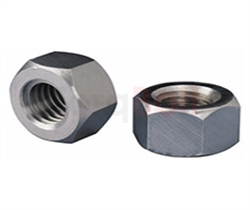
A286 lock nuts come in four primary configurations: (1) Jam nut per DIN 936 / ISO 4035, a thinner hex nut (~0.5 × nominal) used in pairs against a standard hex nut to friction-lock; the assembly is the canonical "double-nut" anti-vibration design. (2) Pellet lock nut, standard hex nut with a nylon or aluminium pellet inserted in a side-wall pocket, friction-engaging the bolt thread without prevailing torque on the primary nut. (3) Slotted nut per DIN 935 / ISO 7037, six radial slots for cotter-pin retention through a transverse hole in the bolt shank. (4) Castle nut per ASME B18.2.2, slotted with raised crown, similar function to slotted but with extra height. Each is upset-forged from A286 hex bar, tapped, then solution-treated 1650 °F + aged 1325 °F per AMS 5737.
TorqBolt produces five primary A286 lock nut configurations:
| Metric size | Wrench AF | Standard hex thickness | DIN 936 jam thickness | DIN 935 slotted thickness | Castle nut thickness |
|---|---|---|---|---|---|
| M6 | 10 mm | 5 mm | 3 mm | 7.5 mm | 10 mm |
| M8 | 13 mm | 6.5 mm | 4 mm | 9.5 mm | 13 mm |
| M10 | 17 mm | 8 mm | 5 mm | 12 mm | 16 mm |
| M12 | 19 mm | 10 mm | 6 mm | 15 mm | 19 mm |
| M16 | 24 mm | 13 mm | 8 mm | 19 mm | 23 mm |
| M20 | 30 mm | 16 mm | 9.5 mm | 22 mm | 29 mm |
| M24 | 36 mm | 19 mm | 12 mm | 27 mm | 33 mm |
| M30 | 46 mm | 24 mm | 15 mm | 33 mm | 40 mm |
Every a286 lock nuts TorqBolt ships traces back to a vacuum-induction-melted plus vacuum-arc-remelted (VIM-VAR) ingot meeting AMS 5731 / 5732 chemistry. The complete process route:
Each lot ships with a signed inspection certificate. Aerospace lots default to AS9102 FAI reporting under our AS9100D AQMS coverage. Industrial orders default to EN 10204 type 3.1. Variant-specific inspection scope:
Lock nut torque depends on the locking mechanism: (1) Jam-nut pair, bottom nut torqued to full preload (75 % yield), top jam nut torqued to 50-60 % of bottom nut's torque. (2) Pellet lock, torqued to full preload; pellet provides friction without affecting seating torque. (3) Slotted / castle, torqued to specified preload, then loosened to align next slot with cotter-pin hole (NEVER tightened beyond preload to align). Cotter pin provides positive lock; preload is set by initial torque only. Above 540 °C apply nickel anti-seize to threads on all variants.
Lock nuts retain primary nut against loosening, applications:
Every A286 fastener is released against the applicable industry standard. EN 10204 type 3.1 mill certificates ship with every order. See the consolidated A286 AMS / ASTM specifications hub.
| Authority | Specification | Coverage |
|---|---|---|
| ASTM | A453 grade 660 Cl. A/B/C/D | High-temperature bolting material |
| ASTM | A638 grade 660 Type 1/2 | Forged bolting stock |
| AMS | 5731 | Bar / forging, solution-treated |
| AMS | 5732 | Bar / forging, solution-treated and aged |
| AMS | 5737 | Bar, sol-treated and aged (precision) |
| UNS | S66286 | Material designation |
| DIN | 1.4980 / X5NiCrTiMoVB25-15-2 | European designation |
| EN | 10204 3.1 / 3.2 | Mill / third-party-witness certification |
Engineers compare A286 against three alternatives: A286 vs Inconel 718, A286 vs 17-4 PH, and A286 vs Waspaloy. Within the 540-700 °C service envelope A286 is the dominant cost-performance choice for non-magnetic, oxidation-resistant bolting. See A286 equivalent grades.
A complete a286 lock nuts callout should include all eight elements: material spec, heat-treatment condition, dimensional standard, size, thread tolerance class, surface finish, marking, inspection certificate. Example callout:
Hex jam nut, DIN 936 (ISO 4035), A286 / UNS S66286, ASTM A453 grade 660 Class A, ST+A, M16 × 2.0, 6H thread, passivated, stamped ‘A286’ + lot, EN 10204 3.1.
Lock nut uses an external retainer (cotter pin, jam nut, pellet) to prevent rotation. Self-locking nut has built-in prevailing torque (nylon insert or deformed thread). Lock nuts are typically more re-usable and higher-temperature; self-locking nuts are simpler to install and more compact.
Thread the standard (full-thickness) nut to position and torque to full preload (75 % yield). Then thread the jam-nut (DIN 936 thin nut) on top and tighten against the standard nut at 50-60 % of the standard's torque. The jam-nut friction-locks against the standard nut, preventing both from rotating.
Jam nuts: indefinitely re-usable. Pellet-lock nuts: 8-10 cycles per IFI-100D before pellet wears. Slotted/castle nuts: indefinitely re-usable but cotter pin must be replaced each cycle. Aerospace primary structure: single-use only per OEM SRM.
DIN 936 jam nuts: yes to 700 °C (full A286 service temp). Pellet-lock with nylon pellet: ≤ 120 °C; with aluminium pellet: ≤ 540 °C. Slotted/castle: yes to 700 °C. Choose pellet material per service temp.
Slotted nut (DIN 935): hex nut with 6 radial slots cut across the top, slot depth ~0.6 × hex thickness. Castle nut (ASME B18.2.2): slotted with raised crown above the slot section, overall taller. Same function (cotter-pin retention) but castle nut allows more cotter-pin clearance.
No. Magnetic permeability < 1.005 verified on every aerospace lot per ASTM A342.
Bottom nut: 75 % of bolt yield (full preload). Top jam nut: 50-60 % of bottom's torque. For M16 grade 660 Class A: bottom 280 N·m, jam 150-170 N·m. Always tighten in this order, bottom first to develop preload, then jam-nut to lock.
Positive mechanical lock from cotter pin, no reliance on friction (which can vary or fail). Used on safety-critical joints where the consequences of loosening are catastrophic: landing gear, control linkages, primary structure. Slotted requires drilled bolt shank for cotter pin.
Cotter pin diameter ≈ 0.2 × bolt nominal: M10 → 2 mm cotter pin (1/16 inch typical). Length ≈ 1.5 × bolt diameter past the nut. ASME B18.8.2 / DIN 94 covers cotter pin sizing.
Three reasons aerospace and gas-turbine OEMs place a286 lock nuts orders with us:
30+ years of fastener-manufacturing track record. Active certifications cover ISO 9001:2015, AS9100D AQMS, PED 2014/68/EU and NORSOK M-650 QTR.
Recurring lock-nut orders: DIN 936 jam-nut pairs on petrochemical heat-exchanger flange bolting, DIN 935 slotted on aerospace flight-control linkages, ASME B18.2.2 castle nut on heavy-truck axle and bearing-housing retention, and pellet-lock variants on subsea connector bodies.