

Specifications
Surface Treatments
Certifications
- ISO 9001 - 2015 Certified
- PED 2014/68/EC
- NACE MR0175/ISO 15156-2
- NORSOK M-650
- DFAR
- MERKBLATT AD 2000 W2/W7/W10

A286 self-locking nuts (also called prevailing-torque nuts, nyloc nuts, stiff nuts) resist loosening under vibration through one of two locking mechanisms: nylon insert (per DIN 985 / IFI-100B) or all-metal prevailing-torque deformed thread profile (per DIN 6927 / IFI-100A / NAS 1291 / MS 21043). TorqBolt manufactures A286 self-locking nuts in M3-M30 metric and #4 to 1-1/4 inch sizes, heat-treated to ASTM A453 grade 660 Class A for matched preload with A286 bolts. The nylon insert (Type II per IFI-100B) operates to 120 °C maximum; all-metal prevailing-torque to 700 °C, choose by service temperature. Aerospace standards NAS 1291 (low-height) and MS 21043 (standard-height) are the dominant aerospace self-locking nuts on US-built jet engines and airframes. See parent A286 nuts, sister hex nuts (no locking), lock nuts (jam-nut), and the canonical chemical composition, heat treatment.
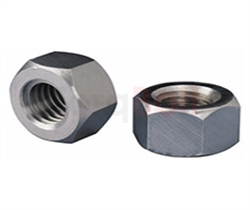
TorqBolt produces three self-locking nut variants on A286 substrate: (1) Nylon-insert self-locking nut per DIN 985, top portion of the nut has a nylon collar inserted; mating bolt threads displace the nylon to create prevailing torque on dis-assembly. Service temp ≤ 120 °C. (2) All-metal prevailing-torque nut per DIN 6927 / IFI-100A, top portion of the nut has 3 or 6 deformed threads (oval-section or distorted) creating spring resistance against the mating bolt. Service temp to 700 °C. (3) Aerospace MS 21043 / NAS 1291, all-metal prevailing torque per MIL-N-25027 with magnetic permeability < 1.005, used on US-spec aerospace assemblies. Each lot is preload-tested per ASTM F606 / NAS 1791 to confirm minimum prevailing torque.
TorqBolt produces five primary A286 self-locking nut configurations:
| Size | DIN 985 (nylon insert) | DIN 6927 (all-metal) | MS 21043 | NAS 1291 | Min. prevailing torque (N·m) |
|---|---|---|---|---|---|
| M3 / #4 | ✓ | ✓ | MS 21043-04 | NAS 1291-04 | 0.2 |
| M5 / #10 | ✓ | ✓ | MS 21043-08 | NAS 1291-08 | 0.6 |
| M6 / 1/4 | ✓ | ✓ | MS 21043-3 | NAS 1291-3 | 1.2 |
| M8 / 5/16 | ✓ | ✓ | MS 21043-4 | NAS 1291-4 | 2.4 |
| M10 / 3/8 | ✓ | ✓ | MS 21043-5 | NAS 1291-5 | 4.5 |
| M12 / 7/16 | ✓ | ✓ | MS 21043-6 | NAS 1291-6 | 8.0 |
| M16 / 1/2 | ✓ | ✓ | MS 21043-8 | NAS 1291-8 | 16 |
| M20 / 5/8 | ✓ | ✓ | MS 21043-10 | NAS 1291-10 | 30 |
Every a286 self-locking nuts TorqBolt ships traces back to a vacuum-induction-melted plus vacuum-arc-remelted (VIM-VAR) ingot meeting AMS 5731 / 5732 chemistry. The complete process route:
Each lot ships with a signed inspection certificate. AS9100D-compliant aerospace lots include AS9102 first-article reporting on every new drawing or revision. Industrial orders default to EN 10204 type 3.1. Variant-specific inspection scope:
Self-locking nuts have two torque components: (1) prevailing-torque (the friction from the locking feature), typically 1-30 N·m for M3-M20 sizes per ASTM F606 / MIL-N-25027 minimum; (2) seating-torque (clamping the joint), torque-on-top-of prevailing required to develop bolt preload. Total assembly torque = prevailing + seating. For M16 A286 self-locking nut: prevailing 16 N·m + seating 280 N·m = 296 N·m total. Critical: the bolt must protrude through the nut by at least 1.5 thread pitches for the locking feature to engage, confirm bolt length on installation.
Self-locking nuts retain preload under vibration, applications:
Every A286 fastener is released against the applicable industry standard. EN 10204 type 3.1 mill certificates ship with every order. See the consolidated A286 AMS / ASTM specifications hub.
| Authority | Specification | Coverage |
|---|---|---|
| ASTM | A453 grade 660 Cl. A/B/C/D | High-temperature bolting material |
| ASTM | A638 grade 660 Type 1/2 | Forged bolting stock |
| AMS | 5731 | Bar / forging, solution-treated |
| AMS | 5732 | Bar / forging, solution-treated and aged |
| AMS | 5737 | Bar, sol-treated and aged (precision) |
| UNS | S66286 | Material designation |
| DIN | 1.4980 / X5NiCrTiMoVB25-15-2 | European designation |
| EN | 10204 3.1 / 3.2 | Mill / third-party-witness certification |
Engineers compare A286 against three alternatives: A286 vs Inconel 718, A286 vs 17-4 PH, and A286 vs Waspaloy. Across the 540-700 °C operating window, A286 delivers the lowest cost per MPa of retained preload. See A286 equivalent grades.
A complete a286 self-locking nuts callout should include all eight elements: material spec, heat-treatment condition, dimensional standard, size, thread tolerance class, surface finish, marking, inspection certificate. Example callout:
Self-locking nut, MS 21043-5, A286 / UNS S66286, ASTM A453 grade 660 Class A, ST+A, M10 thread, MIL-S-8879 thread tolerance, magnetic permeability < 1.005, MIL-N-25027 prevailing-torque tested, head-stamped ‘MS 21043-5’ + lot.
Nylon-insert: nylon collar in the top of the nut creates friction lock against the mating bolt. Service temp ≤ 120 °C (nylon decomposes above). All-metal: top 3-6 threads deformed (oval or distorted) creating mechanical spring resistance. Service temp to 700 °C. Choose by service temperature.
120 °C continuous, 150 °C peak. Above 120 °C the nylon collar softens and loses prevailing torque; above 200 °C nylon decomposes. For service temperatures above 120 °C, use DIN 6927 all-metal prevailing-torque or MS 21043 / NAS 1291 aerospace variants.
DIN 985 nylon-insert: typically 5 cycles before nylon wears out (per IFI-100B). All-metal prevailing-torque DIN 6927 / MS 21043: 15+ cycles per IFI-100A / NAS 1791 with documented torque history. Aerospace primary structure: single-use only per OEM SRM.
MS 21043: standard-height aerospace self-locking nut per MIL-N-25027, full hex height. NAS 1291: low-height (~0.6 × standard) aerospace self-locking, for limited axial clearance applications. Both are all-metal prevailing-torque, A286 / UNS S66286 material, magnetic permeability < 1.005.
No. Magnetic permeability < 1.005 verified on every aerospace lot per ASTM A342. Critical for sensor-isolation on aerospace and instrumentation applications.
All-metal prevailing-torque: yes, retains 85 % of room-temperature locking torque at -196 °C. Nylon-insert DIN 985: NO, nylon embrittles below -40 °C and prevailing torque becomes unreliable. Use all-metal for cryogenic LNG and hydrogen service.
Per MIL-N-25027 / NAS 1791: M3 = 0.2 N·m, M5 = 0.6, M6 = 1.2, M8 = 2.4, M10 = 4.5, M12 = 8.0, M16 = 16, M20 = 30, M24 = 50. Each lot first-cycle prevailing torque tested at 100 % to confirm specification compliance.
Yes, the self-locking nut provides a more reliable, more re-usable, and higher-temperature locking solution than thread-locker + plain nut. Thread-locker (Loctite) decomposes above 200 °C; all-metal self-locking works to 700 °C.
Minimum 1.5 thread pitches (~2-3 mm typical) past the nut top for the locking feature to engage. Less than 1.5 pitches risks the nut backing off; more than 5 pitches has no functional benefit. Specify bolt length to give 2-3 pitch protrusion through the assembled nut.
Three reasons aerospace and gas-turbine OEMs place a286 self-locking nuts orders with us:
Over thirty years in fastener manufacture with current ISO 9001:2015, AS9100D, PED, and NORSOK M-650 quality system audits.
Active self-locking nut applications: MS 21043 / NAS 1291 on jet-engine compressor disc bolting, DIN 985 nylon-insert on automotive turbocharger waste-gate (≤120 °C zone), NAS 1291 low-height on aerospace structural attach, and DIN 6927 all-metal on industrial gas-turbine combustor (>120 °C).