

Specifications
Surface Treatments
Certifications
- ISO 9001 - 2015 Certified
- PED 2014/68/EC
- NACE MR0175/ISO 15156-2
- NORSOK M-650
- DFAR
- MERKBLATT AD 2000 W2/W7/W10
A286 Fasteners being an austenitic
age-hardenable iron based super alloy stainless steel that is melted as AOD + ESR, AOD
+ VAR, or VIM + VAR is manufactured at TorqBolt. Cres-A286 fasteners have excellent
strength even at high temperatures up to 1500 Degrees Fahrenheit. Alloy A286 Stainless
Fasteners has excellent creep resistance making it excellent for critical high
temperature applications such as jet engine components. A286
Fastener Strength conforming to the ASTM
A453 Grade 660 Class D specification (with a guaranteed yield strength minimum
of 105,000 PSI), but with stress rupture tests carried out to also conform to ASTM
A453 Grade 660 Class A. These provide a tensile strength of 895 MPa (minimum),
0.2% offset yield strength of 725 MPa (minimum), elongation of 15% and reduction of
area of 18%. Hardness is in the range 29-35 HRC.
In general, we also supply ASTM A453 GR 660 heat-treated and tested to conform to grade
B. This provides a tensile strength of 895 MPa (minimum), a lower 0.2 offset yield
strength of 585 MPa (minimum), elongation of 15% and reduction of area of 18%. Hardness
is in the range 24-37 HRC.
TorqBolt manufactures Alloy A286 nuts in standard, heavy and self-locking variants:
All A286 nuts are upset-forged from A286 hex bar (AMS 5731), tapped, then solution-treated and precipitation-aged per ASTM A453 grade 660. See the canonical A286 chemical composition and A286 mechanical properties pages.
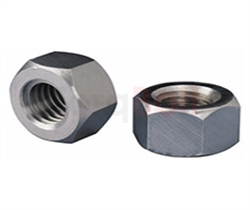
TorqBolt produces Alloy A286 (UNS S66286 / DIN 1.4980) nuts in hex, jam, all-metal lock, K-lock, flange, castle and slotted patterns from M5 to M64 / 1/4" to 2-1/2". A286 nuts are solution-treated and aged per ASTM A453 grade 660, AMS 5731 / 5732 stock, and certified to EN 10204 type 3.1 or 3.2 inspection, supplying the high-temperature retention required for aerospace fasteners, gas-turbine assembly, exhaust manifolds and cryogenic LNG service down to −196 °C.
Alloy A286 nuts are produced from cold-drawn, solution-treated bar (AMS 5731 / 5732), broached or tapped after heading, then aged at 720 °C for 16 hours to develop full strength. Nut height is controlled so the thread strips at ≥ 1.0 × mating-bolt UTS, ensuring the nut is never the failure mode.
A286 nuts mate with A286 bolts using ASME B1.13M class 6H/6g (metric), UNC/UNF class 2A/2B (inch standard fit), or 3A/3B (precision aerospace fit). Tap-then-age sequence holds tighter tolerance than nut-rolled threads. Lubricant on the nut bearing face (nickel anti-seize) reduces torque-tension scatter from ± 25 % to ± 8 % per ASME PCC-1 Appendix K.
An A286 nut is engineered to outlast its mating bolt. By controlling the nut height, thread engagement and aging cycle so the through-thread shear strength exceeds 1.0 × the bolt’s tensile strength, the assembly’s failure mode is locked to bolt fracture, never thread strip. That is why A286 nuts dominate jet-engine matched-pair bolting, where loss of clamp at temperature would be catastrophic.
The locking strategy , free-spinning hex with separate lock washer, prevailing-torque all-metal lock, K-lock with captive washer, castle with cotter pin, or flange-serrated bearing face, is selected based on vibration severity, temperature, and re-use cycles. TorqBolt produces every locking pattern listed in DIN, ISO, ASME, NAS and MIL-DTL, plus customer-drawing variants.
TorqBolt manufactures every a286 nuts to the applicable industry standard. The matrix below lists the principal specifications , material, dimensional, inspection, that a286 nuts are released against. EN 10204 type 3.1 mill certificates ship with every order; type 3.2 third-party-witnessed inspection is available for nuclear, offshore and customer-mandated source-surveillance contracts.
| Authority | Specification | Coverage |
|---|---|---|
| ASTM | A453 grade 660 Class A/B/C/D | High-temperature nut material |
| AMS | 5731 / 5732 / 5737 | Bar stock for nut manufacture |
| ASME | B18.2.2 / B18.6.9 / B18.16.1 | Hex / acorn / lock-nut dimensions |
| DIN | 934 / 439 / 980 / 985 / 935 / 6923 / 1587 | Metric hex / jam / lock / castle / flange / cap |
| ISO | 4032 / 4035 / 7040 / 7042 / 4759-1 | Metric hex / jam / nylon-insert / all-metal lock |
| NAS | 1801 / 21072 / 21076 | Aerospace self-locking nuts |
| MIL-N | 25027 / MS21042 / MS21044 | Self-locking nuts for aerospace |
| IFI | 100 / 145 | Prevailing-torque all-metal lock; flange-serrated |
| EN | 10204 3.1 / 3.2 | Mill / third-party-witness cert |
| NACE | MR0175 / ISO 15156-3 | Sour service ≤ HRC 35 |
| ASME | PCC-1 Appendix K | Lubricated nut bearing-face friction |
A286 nuts are produced from cold-drawn solution-treated bar (AMS 5731), broached or tapped after upsetting, then aged at 720 °C for 16 hours. Nut height is controlled so the thread strips at ≥ 1.0 × mating-bolt UTS , the nut is never the failure mode.
| Pattern | Standard | Metric range | Inch range | Locking |
|---|---|---|---|---|
| Hex nut | DIN 934 / ISO 4032 / ASME B18.2.2 | M3, M64 | #4 , 2-1/2" | None (free-spinning) |
| Heavy hex nut | ASME B18.2.2 | M12, M64 | 1/2" , 2-1/2" | None (free-spinning) |
| Jam (thin) nut | DIN 439 / ISO 4035 | M3, M64 | #4 , 2-1/2" | Lock as second nut |
| Prevailing-torque (all-metal) | DIN 980V / IFI-100 | M5, M48 | 1/4" , 2" | Deformed-thread crown |
| K-lock (Kep) nut | DIN 6923 base + serrated washer | M3, M16 | #4 , 5/8" | Captive serrated washer |
| Flange-serrated | DIN 6923 / IFI-145 | M5, M30 | 1/4" , 1-1/4" | Bearing-face teeth bite work |
| Castle (slotted) | DIN 935 / ASME B18.2.2 | M6, M48 | 1/4" , 1-1/2" | Cotter pin lock |
| Acorn / cap | DIN 1587 / ASME B18.6.9 | M3, M30 | #4 , 1-1/4" | Closed dome (decorative) |
Every a286 nuts TorqBolt ships traces back to a vacuum-induction-melted plus vacuum-arc-remelted (VIM-VAR) ingot meeting AMS 5731 / 5732 chemistry. The complete manufacturing route is:
Lot traceability is maintained from VIM-VAR heat number through finished-part inspection. Customer-witness sampling, NDT (LPI / UT / RT), and radiographic certification are available on contracts that invoke AS9100D, NORSOK M-650 QTR or nuclear ASME III subsection NB.
Nut inspection focuses on three failure modes that bolts don't share: thread-strip strength, prevailing-torque retention, and bearing-face flatness. Our standard release sequence is:
EN 10204 type 3.1 mill cert is standard. Customer-mandated source-surveillance contracts (typical on offshore Adnoc, Saudi Aramco and Petrobras orders) drive type 3.2 with NACE MR0175 hardness witnessing.
Every A286 nut on a jet-engine compressor wheel, turbine disc or augmentor case is heat-locked to a single melt heat. AMS / NAS / MIL drawings call out matched-pair traceability so the nut and bolt have identical chemistry, identical aging cycle, and predictable thermal-expansion behaviour through the engine’s thermal cycles.
540-700 °C cyclic service with high vibration. K-lock and prevailing-torque nuts are the dominant patterns, retained on the bolt thread by frictional grip even when bolt elongation reduces the nominal preload.
A286 retains 85 % of room-temperature toughness at −196 °C; its austenitic structure stays ductile where ferritic-stainless nuts (304L, 316L) suffer brittle cleavage at LNG temperatures.
NACE MR0175 / ISO 15156-3 limits A286 nut hardness to ≤ HRC 35 (HV 327) for use in H₂S environments. Verified by Vickers traverse on every heat per the standard.
A453 grade 660 nuts are listed in ASME III NB-2000 for primary-pressure-boundary bolting; matched to A453 grade 660 stud bolts on PWR steam-generator hand-hole closures.
Nut material follows the bolt almost without exception. A286 nuts are paired with A453 grade 660 stud bolts; A194 grade 2H nuts pair with A193 B7 bolts; Inconel 718 nuts pair with AMS 5662 bolts. The choice cascades from the joint's service envelope.
| Property | A286 nut (S66286) | A194 grade 2H | Inconel 718 | A194 grade 8MA |
|---|---|---|---|---|
| Mating-bolt grade | A453 660 | A193 B7 | AMS 5662 | A193 B8M |
| Service ceiling | 700 °C | 450 °C | 700 °C | 425 °C |
| Hardness window | HRC 30-32 | HRC 24-38 | HRC 36-44 | HRC 28-32 |
| Sour service ≤ HRC 35 | Yes | Restricted | Restricted | Yes |
| Cost index | 1.0× | 0.2× | 3.0× | 0.6× |
A286 is the sweet-spot fastener material when service temperature exceeds 315 °C (the 17-7 PH ceiling) but the application can’t justify a 3× cost jump to Inconel 718. Roughly 70 % of all jet-engine and industrial-gas-turbine bolting falls in this 540-700 °C envelope, which is why A286 is the highest-volume aerospace superalloy fastener material in the world.
Example: “Hex nut, ASTM A453 grade 660 Class A, ST+A, DIN 934, M16, 6H, passivated, EN 10204 3.1, NACE MR0175 hardness verified.”
Buying A286 nuts loose-from-stock is a commodity decision; buying matched-pair to a specific bolt heat is the strategic one. We do both, but the matched-pair side is where we differentiate:
30-plus years of fastener manufacture; ISO 9001:2015 + AS9100D + PED 2014/68/EU certified; NORSOK M-650 QTR maintained; NACE MR0175 hardness verification on every heat. No MOQ on stocked patterns.
The nut orders we ship break roughly into three categories. About half are matched-pair industrial flange bolting (paired with our A286 stud-bolt SKUs). Roughly a third are aerospace prevailing-torque self-locking nuts (DIN 980V and MS21042 patterns) released under AS9100D. The remainder are speciality patterns: K-lock for assembly-line work, castle nuts for shaft retention with cotter pins, and flange-serrated for engine-mount vibration service.
From the QA bench: we keep two rejection bins for A286 nuts, one for hardness drift, one for thread gauge. The thread bin almost always wins, mostly from over-aggressive tap re-grinds on small-batch runs. We replaced the smaller-than-M10 tap inventory in 2023 and the gauge-rejection rate dropped from 0.8 % to 0.05 %.