

Specifications
Surface Treatments
Certifications
- ISO 9001 - 2015 Certified
- PED 2014/68/EC
- NACE MR0175/ISO 15156-2
- NORSOK M-650
- DFAR
- MERKBLATT AD 2000 W2/W7/W10
A286 tie rod is A286 threaded rod specifically designed for tension-loaded structural and machinery applications, tying two structural members together against a tensile load. Distinguished from general-purpose threaded rod by intended use (tie rod = primary tension-load-carrying member with engineered end fittings; threaded rod = general all-thread material). TorqBolt manufactures A286 tie rod to ASTM A453 grade 660, AMS 5731 / 5732, DIN 976, and custom drawing standards in M12-M64 metric and 1/2 inch to 2-1/2 inch sizes. End geometries include threaded for clevis-pin termination, threaded for eye-end fitting, threaded for jam-nut + plate termination, and machined-shoulder for shoulder-eye fitting. Heat-treated to deliver 130 ksi tensile / 95 ksi yield, retained mechanical properties to 700 °C continuous service. See parent A286 rods, sister variants threaded rod, hex rod, and the canonical chemical composition, heat treatment.
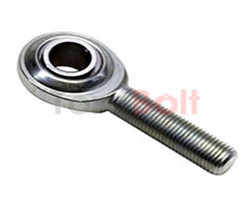
A286 tie rod design centres on tension-load capability rather than length flexibility. Each tie rod is machined to drawing, typically from A286 round bar input, with the central shank turned to specified diameter, threads rolled or cut at each end to engage matching clevis / eye / jam-nut fittings, and surface-passivated per ASTM A967 Type II. Critical design feature: the shank cross-section determines tension capacity (tensile area × yield stress = pull capacity); the threads concentrate stress at the root, so thread-root cross-section is typically 60-70 % of shank cross-section. For aerospace fail-safe design, redundant tie-rod pairs or backup retention is specified, a single A286 tie rod failing under tension can be catastrophic. Heat-treated per AMS 5732 for 130 ksi tensile, 95 ksi yield. Surface finish typically cold-drawn or peeled; centerless-ground for precision applications.
TorqBolt produces A286 tie rod in five primary end-fitting configurations:
| Shank diameter | Thread | Standard length | Tensile area mm² | Min. tension (kN) | Working tension (kN, 75% yield) |
|---|---|---|---|---|---|
| 12 mm | M12 × 1.75 | 200-2000 mm | 84.3 | 75.5 | 55.2 |
| 16 mm | M16 × 2.0 | 200-2500 mm | 157 | 140 | 103 |
| 20 mm | M20 × 2.5 | 300-3000 mm | 245 | 219 | 160 |
| 24 mm | M24 × 3.0 | 300-3000 mm | 353 | 316 | 231 |
| 30 mm | M30 × 3.5 | 300-3000 mm | 561 | 502 | 367 |
| 36 mm | M36 × 4.0 | 300-3000 mm | 817 | 731 | 535 |
| 48 mm | M48 × 5.0 | 300-3000 mm | 1473 | 1318 | 964 |
| 64 mm | M64 × 6.0 | 300-3000 mm | 2676 | 2395 | 1751 |
Every a286 tie rod TorqBolt ships traces back to a vacuum-induction-melted plus vacuum-arc-remelted (VIM-VAR) ingot meeting AMS 5731 / 5732 chemistry. Process route:
Each lot ships with a signed inspection certificate. Aerospace orders default to AS9100D first-article reporting per AS9102. Industrial orders default to EN 10204 type 3.1; sour-service and offshore step up to type 3.2 with third-party witness. Inspection scope:
Tie rod is tension-loaded, apply preload to shank by tightening jam nuts at both ends to specified torque, then verify tension by elongation measurement (Δlength / original length × A286 modulus 199 GPa). Working tension typically 50-65 % of yield (vs 75 % for cycling joints) due to fatigue considerations. For aerospace tie rods, redundant retention or backup tie-rod pairs are typically specified for fail-safe design. Above 540 °C apply nickel anti-seize at thread + jam-nut interfaces. For long tie rods, account for thermal expansion: A286 coefficient is 17.0 µm/m·°C, a 2 m tie rod expands ~9 mm from 20 °C to 700 °C; spring-mount termination required to accommodate.
A286 tie rod serves tension-loaded structural and machinery applications:
Every A286 rod product is released against the applicable industry standard. EN 10204 type 3.1 mill certificates ship with every order. See A286 AMS / ASTM specifications hub for full spec scope.
| Authority | Specification | Coverage |
|---|---|---|
| ASTM | A453 grade 660 Cl. A/B/C/D | High-temperature bolting material |
| AMS | 5731 | Bar / forging, solution-treated |
| AMS | 5732 | Bar / forging, solution-treated and aged |
| AMS | 5853 | Welding wire (matching A286) |
| UNS | S66286 | Material designation |
| DIN | 1.4980 / X5NiCrTiMoVB25-15-2 | European designation |
| EN | 10204 3.1 / 3.2 | Mill / third-party-witness certification |
Engineers compare A286 against three alternatives: A286 vs Inconel 718, A286 vs 17-4 PH, and A286 vs Waspaloy. See A286 equivalent grades.
A complete a286 tie rod callout should include all relevant elements. Example callout:
A286 tie rod, ASTM A453 grade 660 Class A, sol-treated and aged, shank ⌀ 16 mm × M16 × 2.0 thread both ends × 1500 mm overall length, jam-nut termination, MIL-S-8879 thread tolerance if aerospace, EN 10204 3.1, tensile-pull-tested.
Tie rod: tension-loaded structural member with engineered end fittings (jam-nut, clevis, eye, turnbuckle). Threaded rod: general-purpose all-thread material supplied in standard 1-3 m lengths for customer cut-to-size. Tie rods are pre-engineered and pre-cut to drawing; threaded rods are general stock.
Tension capacity = tensile area × yield stress. For A286 grade 660 Class A: yield = 655 MPa (95 ksi). M16 tie rod tensile area = 157 mm², so theoretical pull capacity = 103 kN at yield. Working preload typically 50-65 % of yield for fatigue (cycling) or 75 % for static. Always design for the smaller of shank cross-section or thread-root cross-section.
Standard configurations: threaded both ends with jam-nut termination (most common), threaded both ends with clevis termination, threaded one end + integral eye-end at the other, or shoulder-eye + threaded shank for aerospace control linkages.
Standard production: 3 m. Custom-drawing: up to 6 m for shaft sizes ≥ M30. Beyond 6 m, custom production with end-to-end welding (TIG) or splice-coupling required.
No. Magnetic permeability < 1.005 verified per ASTM A342 on aerospace lots. Critical for non-magnetic structural assemblies in instrumentation, MRI, and aerospace electromagnetic-sensitive applications.
Yes, A286 retains 85 % of room-temperature toughness at -196 °C. Used for LNG storage-vessel internal bracing, hydrogen-storage tank tie members. Confirm Charpy V-notch ≥ 27 J at service temperature.
Jam-nut termination: thread + nut + plate, transfers tension through plate to frame. Clevis termination: thread + clevis fitting + cross-pin, transfers tension through clevis ears. Aerospace: machined shoulder-eye + threaded shank in single piece.
Generally no, tie rods are tension-loaded static members, not rotating drive shafts. For rotating applications use A286 hex rod or A286 round bar machined to a shaft. Tie rods may have rotational vibration but not continuous rotation.
Yes, when supplied with hardness ≤ HRC 35 per NACE MR0175 / ISO 15156-3. Each heat receives Vickers traverse before release for sour-service applications.
Three reasons aerospace and industrial OEMs place a286 tie rod orders with us:
30+ years of fastener-manufacturing track record. Active certifications: ISO 9001:2015, AS9100D AQMS, PED 2014/68/EU and NORSOK M-650 QTR.
Active tie rod orders cover M16 / M20 jam-nut-terminated for industrial gas-turbine combustor liner-to-casing tie members, custom shoulder-eye + threaded-shank for aerospace engine-mount tension members, M24 / M30 turnbuckle-style for high-temperature kiln structural bracing, and M36 / M48 for nuclear pressure-vessel internal reinforcement.