

Specifications
Surface Treatments
Certifications
- ISO 9001 - 2015 Certified
- PED 2014/68/EC
- NACE MR0175/ISO 15156-2
- NORSOK M-650
- DFAR
- MERKBLATT AD 2000 W2/W7/W10

A286 lock washers are spring-action washers placed under hex nuts or bolt heads to maintain residual clamping force as the joint relaxes from thermal cycling, vibration or settling. TorqBolt manufactures four primary A286 lock washer types: split-ring (helical spring per DIN 127 / ISO 7090), Belleville disc spring (conical disc per DIN 6796), external-tooth (radial teeth per DIN 6797 / IFI-101), and internal-tooth (inward teeth per DIN 6798 / IFI-101). Stamped or laser-cut from A286 sheet (AMS 5895) or plate (AMS 5525), then solution-treated and aged to develop spring-back. Sizes M3-M30 metric and #4-1/2 inch. Note: at temperatures above ~540 °C, lock washers lose spring-back due to material yield, for high-temperature anti-vibration use A286 self-locking nuts instead. See parent A286 washers, sister flat washers, and the canonical chemical composition, heat treatment.
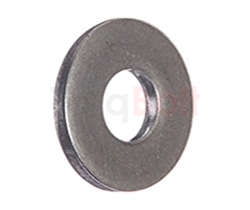
A286 lock washers achieve their anti-loosening function through stored spring energy, when the joint clamps, the washer compresses; if the joint relaxes (thermal contraction, settlement, vibration micro-creep), the washer spring-back maintains residual clamping force. Each lock washer is blanked from A286 sheet, formed to the required spring profile (helical for split-ring, conical for Belleville, tooth-stamped for serrated), then solution-treated 1650 °F and aged 1325 °F × 16 hours to develop the gamma-prime precipitation that gives A286 its spring properties. Hardness 277-302 HBW post-aging. The non-magnetic austenitic matrix makes A286 lock washers compatible with same-material A286 bolt-and-nut joints at temperatures from -196 °C cryogenic to ~540 °C (above which spring-back diminishes).
TorqBolt produces four primary A286 lock washer configurations:
| For bolt size | Split-ring (DIN 127) | Belleville (DIN 6796) | Tooth (DIN 6797) | Inner ⌀ | Outer ⌀ | Thickness |
|---|---|---|---|---|---|---|
| M3 | ✓ | ✓ | ✓ | 3.1 mm | 6.2 mm | 0.8 mm |
| M4 | ✓ | ✓ | ✓ | 4.1 mm | 7.6 mm | 0.9 mm |
| M5 | ✓ | ✓ | ✓ | 5.1 mm | 9.2 mm | 1.2 mm |
| M6 | ✓ | ✓ | ✓ | 6.1 mm | 11.8 mm | 1.6 mm |
| M8 | ✓ | ✓ | ✓ | 8.1 mm | 14.8 mm | 2.0 mm |
| M10 | ✓ | ✓ | ✓ | 10.2 mm | 18.1 mm | 2.2 mm |
| M12 | ✓ | ✓ | ✓ | 12.2 mm | 21.1 mm | 2.5 mm |
| M16 | ✓ | ✓ | ✓ | 16.2 mm | 27.4 mm | 3.5 mm |
| M20 | ✓ | ✓ | 20.2 mm | 33.6 mm | 4.0 mm | |
| M24 | ✓ | ✓ | 24.5 mm | 40.0 mm | 5.0 mm |
Every a286 lock washers TorqBolt ships traces back to a vacuum-induction-melted plus vacuum-arc-remelted (VIM-VAR) ingot meeting AMS 5731 / 5732 chemistry. The complete process route:
Each lot ships with a signed inspection certificate. Aerospace orders are released with AS9102 first-article inspection per AS9100D AQMS. Industrial orders default to EN 10204 type 3.1. Variant-specific inspection scope:
Lock washers compress under bolt preload, they do NOT add to the bolt clamping force calculation. The bolt is torqued to its specified preload; the lock washer compresses and stores spring energy. As the joint relaxes (thermal cycling, settling), the lock washer spring-back maintains residual clamping. CRITICAL: lock washers stack only one per joint side, multiple stacked lock washers cause unpredictable spring-rate behaviour and unreliable preload. Above ~540 °C the A286 lock washer loses spring-back due to material yield, for high-temperature anti-vibration use jam-nut pair or all-metal self-locking nut instead.
Lock washers retain joint preload under thermal cycling and vibration, applications:
Every A286 fastener is released against the applicable industry standard. EN 10204 type 3.1 mill certificates ship with every order. See the consolidated A286 AMS / ASTM specifications hub.
| Authority | Specification | Coverage |
|---|---|---|
| ASTM | A453 grade 660 Cl. A/B/C/D | High-temperature bolting material |
| ASTM | A638 grade 660 Type 1/2 | Forged bolting stock |
| AMS | 5731 | Bar / forging, solution-treated |
| AMS | 5732 | Bar / forging, solution-treated and aged |
| AMS | 5737 | Bar, sol-treated and aged (precision) |
| UNS | S66286 | Material designation |
| DIN | 1.4980 / X5NiCrTiMoVB25-15-2 | European designation |
| EN | 10204 3.1 / 3.2 | Mill / third-party-witness certification |
Engineers compare A286 against three alternatives: A286 vs Inconel 718, A286 vs 17-4 PH, and A286 vs Waspaloy. A286 is the cost-performance leader for non-magnetic precipitation-hardening service in the 540-700 °C envelope. See A286 equivalent grades.
A complete a286 lock washers callout should include all eight elements: material spec, heat-treatment condition, dimensional standard, size, thread tolerance class, surface finish, marking, inspection certificate. Example callout:
Lock washer, DIN 127 split-ring, A286 / UNS S66286, ASTM A453 grade 660, AMS 5895 aged, ID 8.1 mm, OD 14.8 mm, thickness 2.0 mm, passivated, EN 10204 3.1.
Flat washer: simple flat ring, distributes bearing pressure. See A286 flat washers. Lock washer: spring-action washer (split-ring, Belleville, or toothed) that maintains residual clamping force when joint relaxes. Use both: flat washer for bearing distribution + lock washer for vibration retention.
Engineering opinion is divided. Studies (NASA, Junker test) show split-ring washers are LESS effective than self-locking nuts or Belleville stacks for vibration retention. Modern aerospace and high-criticality engineering prefers self-locking nuts (MS 21043 / NAS 1291) or Belleville disc-spring stacks. Split-ring is acceptable for low-criticality industrial applications.
Belleville disc: conical disc with very high spring constant, stores significant energy in small deflection, retains 90 % preload through thermal cycle. Split-ring: helical spring with low spring constant, stores less energy, retains ~60 % preload. Belleville for safety-critical and high-cycle joints; split-ring for low-cost industrial.
No. Above ~540 °C A286 yields and loses spring-back; the lock washer compresses permanently and stops providing anti-loosening function. For high-temperature anti-vibration use jam-nut pair (DIN 936) or all-metal self-locking nut (DIN 6927 / MS 21043 / NAS 1791).
No. Magnetic permeability < 1.005 verified on every aerospace lot per ASTM A342. Compatible with same-alloy A286 bolt-and-nut joints in instrumentation, MRI, and electromagnetic-sensitive applications.
No. Stacked lock washers cause unpredictable spring-rate behaviour and unreliable preload. Use ONE lock washer per joint side. For higher spring force use a Belleville disc stack (multiple Belleville washers in series or parallel arrangement), this is properly engineered.
Aerospace primary structure: typically NOT lock washers, use self-locking nuts (MS 21043 / NAS 1291) or castle nuts with cotter pins instead. Lock washers used on aerospace SECONDARY: avionics enclosures, accessory gearbox covers, internal-tooth (DIN 6798) preferred.
No. Lock washer compensates for joint relaxation only, it does NOT distribute bearing pressure across a wider area. Use BOTH: flat washer (closer to joint) for bearing distribution, lock washer (under nut/bolt-head) for retention. Single-washer use is acceptable only on hardened steel joint surfaces where bearing damage is not a concern.
Per DIN 6796: highly variable by size and material thickness. M16 A286 Belleville: ~ 50,000 N/mm spring rate, max deflection 0.4 mm at 20,000 N load. Used in stacks (parallel for higher load, series for greater deflection) to match joint preload requirements.
Three reasons aerospace and gas-turbine OEMs place a286 lock washers orders with us:
Three decades of fastener manufacturing experience; current certifications: ISO 9001:2015, AS9100D, PED 2014/68/EU, NORSOK M-650 QTR.
Recurring lock-washer applications: DIN 127 split-ring M6/M8 on aerospace electronic enclosure bolting, DIN 6796 Belleville disc M10/M12 on landing-gear pivot bolts, DIN 6797 external-tooth M5 on transformer terminals, and Belleville stacks for nuclear-grade reactor-vessel bolting M30.