
Specifications
Surface Treatments
Certifications
- ISO 9001 - 2015 Certified
- PED 2014/68/EC
- NACE MR0175/ISO 15156-2
- NORSOK M-650
- DFAR
- MERKBLATT AD 2000 W2/W7/W10
A286 hollow bar is round-cross-section A286 bar with a concentric central bore, produced by trepanning solid round bar or by hot extrusion through a hollow die. Used as raw stock for sleeves, bushings, valve stems with internal porting, and machined components requiring a cylindrical bore eliminating the need for downstream gun-drilling. TorqBolt manufactures A286 hollow bar to AMS 5731 / 5732, ASTM A453 grade 660, and ASTM B637 standards in OD 25-200 mm with ID 10-150 mm. OD : ID ratios from 1.3:1 (thick wall) to 4:1 (thin wall). Heat-treated per AMS 5732 to deliver 130 ksi tensile / 95 ksi yield, retained mechanical properties to 700 °C continuous service. Distinguished from A286 tube/tubing by the heavier wall thickness and primary use as machining stock vs pressure-bearing fluid conveyance. See parent A286 bar stock, sister variants round bar, forged bar, and the canonical chemical composition, heat treatment.
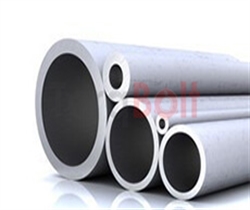
A286 hollow bar is produced by two routes: (1) trepanning, solid hot-rolled round bar bored through with a trepanning tool that removes a central solid core, leaving a hollow tube; and (2) hot extrusion, billet pierced and extruded through a die-and-mandrel set to form hollow stock in a single operation. Trepanning produces hollow bar with smooth, concentric bore and tight OD/ID tolerance; extrusion is more economical for high-volume standard sizes. Wall thickness ratios typically 5-30 mm depending on application. Used for valve stems with internal porting, fluid manifold bodies, hydraulic actuator pistons with internal hydraulic passage, and aerospace shaft assemblies requiring through-bore. Each lot is solution-treated and aged per AMS 5732, surface-pickled and bore-honed if specified, and ships with EN 10204 3.1 mill cert.
TorqBolt produces A286 hollow bar via three production routes:
| OD × ID | Wall thickness | Production route | OD tolerance | ID tolerance | Available specs |
|---|---|---|---|---|---|
| 25 × 10 mm | 7.5 mm | Trepanned / Extruded | +0.30 / -0 | +0.20 / -0 | AMS 5731 / 5732 |
| 38 × 19 mm | 9.5 mm | Trepanned / Extruded | +0.30 / -0 | +0.30 / -0 | AMS 5731 / 5732 |
| 50 × 25 mm | 12.5 mm | Trepanned / Extruded | +0.40 / -0 | +0.30 / -0 | AMS 5731 / 5732 |
| 75 × 38 mm | 18.5 mm | Trepanned | +0.50 / -0 | +0.40 / -0 | AMS 5731 / 5732 |
| 100 × 50 mm | 25 mm | Trepanned | +0.60 / -0 | +0.50 / -0 | AMS 5731 / 5732 |
| 150 × 75 mm | 37.5 mm | Trepanned / Forged | +1.00 / -0 | +0.80 / -0 | AMS 5731 |
| 200 × 100 mm | 50 mm | Forged + trepanned | +1.50 / -0 | +1.00 / -0 | AMS 5731 / B637 |
Every a286 hollow bar TorqBolt ships traces back to a vacuum-induction-melted plus vacuum-arc-remelted (VIM-VAR) ingot meeting AMS 5731 / 5732 chemistry. The complete process route:
Each lot ships with a signed inspection certificate. Aerospace orders default to AS9100D first-article reporting per AS9102. Industrial orders default to EN 10204 type 3.1; sour-service and offshore step up to type 3.2 with third-party witness. Inspection scope:
Hollow bar is raw stock, torque does not apply directly. Downstream machining and forming: thin-wall hollow bar (wall < 5 mm) is more sensitive to chuck distortion; use soft jaws or 4-jaw self-centering chucks. Pressure-rating of finished hollow components follows ASME PCC-1 / B31.3 calculations using the wall thickness, OD, and A286 yield stress at temperature. For high-pressure hydraulic actuators, design wall thickness for 4× safety factor over working pressure to allow for fatigue cycling.
A286 hollow bar serves machining-stock applications requiring central bore:
Every A286 bar product is released against the applicable industry standard. EN 10204 type 3.1 mill certificates ship with every order. See the consolidated A286 AMS / ASTM specifications hub for full spec scope.
| Authority | Specification | Coverage |
|---|---|---|
| ASTM | A453 grade 660 Cl. A/B/C/D | High-temperature bolting material |
| ASTM | A638 grade 660 Type 1/2 | Forged bolting stock |
| ASTM | B637 | Precipitation-hardenable bar |
| AMS | 5731 | Bar / forging, solution-treated |
| AMS | 5732 | Bar / forging, solution-treated and aged |
| AMS | 5737 | Bar, sol-treated and aged (precision) |
| UNS | S66286 | Material designation |
| DIN | 1.4980 / X5NiCrTiMoVB25-15-2 | European designation |
| EN | 10204 3.1 / 3.2 | Mill / third-party-witness certification |
Engineers compare A286 bar against three alternatives: A286 vs Inconel 718, A286 vs 17-4 PH, and A286 vs Waspaloy. See A286 equivalent grades.
A complete a286 hollow bar callout should include: material spec, heat-treatment condition, dimensional standard, size, surface finish, marking, inspection certificate. Example callout:
A286 hollow bar, AMS 5732, ASTM A453 grade 660 Class A, sol-treated and aged, OD 50.0 mm × ID 25.0 mm × wall 12.5 mm, length 3000 mm, trepanned route, +0.40/-0 OD × +0.30/-0 ID tolerance, EN 10204 3.1.
Hollow bar is round A286 with a concentric central bore, used as raw stock for sleeves, bushings, valve stems with internal porting, hydraulic actuator pistons, and machined components requiring a cylindrical bore. Eliminates downstream gun-drilling operation.
Hollow bar: heavier wall thickness (typ. 5-50 mm), primary use as machining stock for downstream components. Tube: thinner wall, primary use as fluid-conveyance pipe per ASME B31. A286 tubes are pressure-bearing; hollow bar is raw machining stock.
Trepanned: tighter OD/ID concentricity, smoother bore, used for precision sleeves and bushings. Extruded: more economical for standard sizes, slightly less concentric. Cold-drawn extruded hollow stock approaches trepanned precision at lower cost.
Standard production: 200 mm OD via trepanned or forged + trepanned route. Custom: up to 300 mm OD via centrifugal casting. Above 300 mm OD, custom forgings (not bar) are typically specified.
Trepanned: ~5 mm minimum (limited by trepanning tool diameter). Extruded: ~3 mm minimum. Cold-drawn over mandrel: down to 1 mm wall on small OD. For thin-wall pressure tubing < 3 mm, use A286 tubes/tubing instead.
Yes, 100 % UT per ASTM A388 with straight-beam transducer for trepanned and forged variants. Detects internal flaws around the bore. Aerospace and nuclear lots add Class 1 sensitivity acceptance criteria.
Standard sizes OD 25-100 mm: 6-10 weeks from heat release. Larger sizes 100-200 mm: 10-14 weeks. Custom forged + trepanned > 200 mm: 14-20 weeks. Aerospace AS9102 first-article: add 1-2 weeks.
Yes, internal bore honed to Ra ≤ 0.8 µm (typ. 0.4-0.8 µm) for precision sleeve and bushing applications. Specify on PO; adds 2-3 weeks lead time and ~25 % cost premium.
No. Magnetic permeability < 1.005 verified per ASTM A342. Preserved through trepanning, extrusion, sol-treatment, and aging. Compatible with non-magnetic instrumentation, MRI, and aerospace electromagnetic-sensitive shaft and bushing assemblies.
Three reasons aerospace and gas-turbine OEMs place a286 hollow bar orders with us:
Over thirty years in fastener manufacture with active ISO 9001:2015, AS9100D, PED, and NORSOK M-650 quality system audits.
Active hollow bar orders cover OD 38 × ID 19 mm trepanned for aerospace valve-stem manufacture, OD 75 × ID 38 mm extruded for hydraulic actuator pistons, custom OD 150 × ID 75 mm forged + trepanned for nuclear pressure-vessel cladding sleeves, and AMS 5732 OD 50 × ID 25 mm cold-drawn precision for instrumentation bushings.