

Specifications
Surface Treatments
Certifications
- ISO 9001 - 2015 Certified
- PED 2014/68/EC
- NACE MR0175/ISO 15156-2
- NORSOK M-650
- DFAR
- MERKBLATT AD 2000 W2/W7/W10
A286 hex nuts are the canonical mating fastener for A286 hex bolts, A286 bolts and A286 stud bolts. Manufactured by TorqBolt to DIN 934, ISO 4032 (Type 1 standard), ISO 4033 (Type 2 heavy), and ASME B18.2.2 dimensional standards in M5-M64 metric and 1/4"-2-1/2" inch series. Each A286 hex nut is upset-forged from A286 hex bar (AMS 5731 / 5736), tapped, then solution-treated and precipitation-aged to develop the full Class 8 mechanical strength. Pair with A286 hex bolts to form a fully matched A286 bolted joint that retains preload to 700 °C, see parent A286 nuts overview, sister variants self-locking nuts, lock nuts, and the canonical A286 mechanical properties, chemical composition, heat treatment pages.
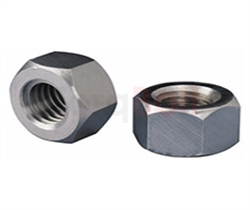
TorqBolt produces Alloy A286 (UNS S66286) hex nuts in three thickness types: Type 0 thin (~0.5d, ISO 4035), Type 1 standard (~0.8d, ISO 4032 / DIN 934, the default), and Type 2 heavy (~0.9d, ISO 4033 / DIN 6330). All are six-flat external hex with internal threaded hole, hot-upset from A286 hex bar (AMS 5731), thread-tapped, solution-treated 1650 °F (899 °C), and aged 1325 °F (718 °C) for 16 hours. Hardness 24-37 HRC, proof load 130 ksi (895 MPa), guaranteed at -196 °C and 700 °C. The non-magnetic austenitic matrix (permeability ≈ 1.001) makes A286 hex nuts compatible with the same instrumentation, MRI, electronic and aerospace electromagnetic-sensitive joints as A286 hex bolts.
Three primary hex nut profiles are produced:
| Metric size | Pitch (coarse) | Wrench AF | Standard thickness | Heavy thickness | Proof load (kN) |
|---|---|---|---|---|---|
| M6 | 1.0 | 10 mm | 5 mm | 5.5 mm | 20.0 |
| M8 | 1.25 | 13 mm | 6.5 mm | 7.5 mm | 36.4 |
| M10 | 1.5 | 17 mm | 8 mm | 9.5 mm | 57.8 |
| M12 | 1.75 | 19 mm | 10 mm | 12 mm | 84.0 |
| M16 | 2.0 | 24 mm | 13 mm | 16 mm | 157 |
| M20 | 2.5 | 30 mm | 16 mm | 19 mm | 244 |
| M24 | 3.0 | 36 mm | 19 mm | 22 mm | 353 |
| M30 | 3.5 | 46 mm | 24 mm | 27.5 mm | 560 |
Every a286 hex nuts TorqBolt ships traces back to a vacuum-induction-melted plus vacuum-arc-remelted (VIM-VAR) ingot meeting AMS 5731 / 5732 chemistry. The complete process route is variant-specific:
Each lot ships with a signed inspection certificate. Aerospace orders default to AS9100D first-article reporting per AS9102 on the first part of any new drawing or revision. Industrial orders default to EN 10204 type 3.1; sour-service and offshore orders step up to type 3.2 with third-party witness present at heat-treat release and tensile testing. Variant-specific inspection scope:
TorqBolt’s quality file maintains the audited NORSOK M-650 QTR for A286 fastener manufacture, renewed every 5 years. Customer-witnessed source surveillance is welcomed.
A286 hex nuts torque to the same proof-load as their mating A286 hex bolts, the nut-to-bolt match is critical to avoid over-stressing the weaker member. ASTM F606 prescribes proof-load testing the assembled joint: nut applied to a high-strength threaded mandrel + tightened to specified proof load + held for 15 seconds without thread strip. For the M16 grade-660 Class A combination: proof load 157 kN (35,300 lbf), torque-to-yield 280 N·m oil / 180 N·m anti-seize. Heavy hex (Type 2) does NOT increase proof load (limited by bolt strength), but provides higher bearing area on softer mating surface. Above 540 °C apply nickel anti-seize to inner thread bore, austenitic-stainless threads gall above this temperature.
Hex nuts pair with hex bolts and stud bolts to complete the bolted joint. Industry uses:
Every A286 fastener is released against the applicable industry standard. EN 10204 type 3.1 mill certificates ship with every order; type 3.2 third-party-witnessed inspection is available for nuclear, offshore and customer-mandated source-surveillance contracts. See the consolidated A286 AMS / ASTM specifications hub for full spec scope.
| Authority | Specification | Coverage |
|---|---|---|
| ASTM | A453 grade 660 Cl. A/B/C/D | High-temperature bolting material |
| ASTM | A638 grade 660 Type 1/2 | Forged bolting stock |
| AMS | 5731 | Bar / forging, solution-treated |
| AMS | 5732 | Bar / forging, solution-treated and aged |
| AMS | 5737 | Bar, solution-treated and aged (precision) |
| UNS | S66286 | Material designation |
| DIN | 1.4980 / X5NiCrTiMoVB25-15-2 | European designation |
| EN | 10204 3.1 / 3.2 | Mill / third-party-witness certification |
| NACE | MR0175 / ISO 15156-3 | Sour-service hardness limit ≤ HRC 35 |
When selecting a fastener material engineers compare A286 against three alternatives: A286 vs Inconel 718 (top-end performance, 3× cost), A286 vs 17-4 PH (cheaper but limited to 315 °C), and A286 vs Waspaloy (sustained service > 700 °C). A286 is the cost-performance leader for non-magnetic precipitation-hardening service in the 540-700 °C envelope. See the consolidated A286 equivalent grades reference for full alloy alternatives.
A complete a286 hex nuts callout on a drawing or purchase order should include all eight elements: material spec, heat-treatment condition, dimensional standard, size, thread tolerance class, surface finish, marking, inspection certificate. Example complete callout:
Hex nut, ASTM A453 grade 660 Class A, ST+A, DIN 934 Type 1 standard, M16 × 2.0, 6H, passivated, stamped ‘A286’ + lot, EN 10204 3.1.
Type 1 (standard, ISO 4032 / DIN 934) thickness ≈ 0.8 × nominal diameter. Type 2 (heavy, ISO 4033 / ASME B18.2.2) thickness ≈ 0.9 × nominal, gives higher bearing area. Use Type 2 for ASME flange bolting, structural connections, and high-temperature joints.
Mechanically yes, but galling is a concern: austenitic-stainless on austenitic-stainless threads gall above 540 °C. Apply nickel or copper anti-seize, or use a different alloy mating combination. For aerospace-critical joints, match A286 nuts to A286 bolts only.
157 kN (35,300 lbf) for ASTM A453 grade 660 Class A material, equal to the proof load of the mating M16 A286 hex bolt at 130 ksi proof stress on M16 stress area 157 mm². Heavy hex Type 2 has the same proof load, the difference is bearing area, not strength.
No. A286 austenitic matrix has magnetic permeability ≈ 1.001, essentially non-magnetic. This is preserved through cold work and aging, making A286 hex nuts compatible with MRI, mass spectrometer, magnetometer, and electromagnetic-sensitive aerospace assemblies.
Hex flange nut has an integral flange that spreads bearing pressure under the nut, eliminates the need for a separate flat washer. Standard hex nut requires a separate A286 flat washer. Hex flange nuts (DIN 6923) are common on automotive and exhaust-system applications.
Yes, TorqBolt produces A286 self-locking nuts (nylon insert per DIN 985 or all-metal prevailing-torque per IFI-100) and A286 lock nuts (jam-nut and pellet-lock variants). Choose self-locking for cycling joints, jam nuts for static joints with vibration risk.
ASTM F606 procedure: nut threaded onto a hardened steel mandrel of specified strength, tightened to proof load (130 ksi for grade 660 Class A), held 15 seconds, then removed. Pass criterion: no thread strip, no visible yielding of nut. Each lot is sampled at 1 nut per 1000.
24-37 HRC after solution-treatment + aging per ASTM A453 grade 660. Nuts are intentionally aged to slightly lower hardness than mating bolts (32-37 HRC bolt vs 24-30 HRC nut) so that yield distributes across nut threads, not bolt threads, the 'sacrificial nut' design principle.
Yes when hardness verified ≤ HRC 35. TorqBolt aging schedules for sour-service nuts target the upper end of the hardness range (32-34 HRC) to balance NACE compliance with adequate proof load. Each heat receives a Vickers traverse before release.
Three reasons aerospace and gas-turbine OEMs place a286 hex nuts orders with us:
30+ years in fastener manufacture; no MOQ on stocked DIN / ISO patterns; ISO 9001:2015 + AS9100D + PED 2014/68/EU + NORSOK M-650 QTR all current. Lot traceability runs from VIM-VAR melt heat number through finished-part packaging.
Recurring hex-nut order categories: petrochemical refinery flange bolting (M24 heavy hex), aerospace engine matched-pair lots (NAS 1291-style bolt + nut), gas-turbine casing-split bolting (M30), and oilfield downhole-tool body retention (1-inch UNF NACE-verified). Matched-pair bolt + nut traceability is the recurring requirement.