

Specifications
Surface Treatments
Certifications
- ISO 9001 - 2015 Certified
- PED 2014/68/EC
- NACE MR0175/ISO 15156-2
- NORSOK M-650
- DFAR
- MERKBLATT AD 2000 W2/W7/W10
A286 hex bolts (also written A-286 hex head bolts, UNS S66286 hex cap screws) are the highest-volume A286 fastener variant, manufactured by TorqBolt to DIN 931 (partial thread), DIN 933 (full thread), ISO 4014 / 4017, ASME B18.2.1 heavy-hex, and aerospace NAS 6603-6620 / NAS 1303-1320 standards. Forged from AMS 5731 / 5732 / 5737 bar, solution-treated and precipitation-aged to ASTM A453 grade 660 Class A, 130 ksi (895 MPa) tensile, 95 ksi (655 MPa) yield, retained preload to 700 °C. The standard external-hex wrenching geometry makes hex bolts the default high-strength fastener for jet engine compressor casing flanges, gas-turbine combustor liner attachment, automotive turbocharger waste-gates, and ASME III nuclear pressure-vessel bolting. See parent A286 bolts overview, sister variants CRES bolts, socket head cap screws, and the canonical A286 chemical composition + mechanical properties + heat treatment pages. For hex bolts in alloys other than A286 (Inconel, Monel, duplex, carbon-steel grades), TorqBolt operates a dedicated hex bolt portfolio site.
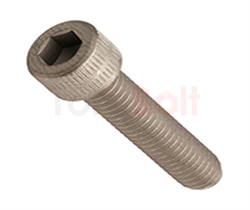
TorqBolt manufactures Alloy A286 (UNS S66286 / DIN 1.4980) hex bolts in metric M5-M64, UNC, UNF and 8-UN inch series 1/4"-2-1/2". The defining feature is the external six-flat hex head, wrench across-flats per DIN/ISO/ASME standard, 30° internal chamfer per ISO 4014 (reduces stress concentration). Each hex bolt is forged from A286 bar stock (AMS 5731 cold-drawn or AMS 5732 hot-rolled), thread-rolled (not cut) for surface fatigue strength, then solution-treated 1650 °F (899 °C) + aged 1325 °F (718 °C) for 16 hours per AMS 5737 / ASTM A453 Class A. Result: 130 ksi (895 MPa) tensile minimum, 95 ksi (655 MPa) 0.2 % yield, 15 % elongation, hardness 29-35 HRC. The non-magnetic austenitic matrix (permeability ≈ 1.001) makes A286 hex bolts the choice for instrumentation, MRI, electronic enclosures and aerospace electromagnetic-sensitive joints.
Three geometric variants of the hex bolt head are produced by TorqBolt:
| Metric size | Pitch (coarse) | Wrench AF | Tensile area mm² | Min. tensile load (kN) |
|---|---|---|---|---|
| M6 | 1.0 | 10 mm | 20.1 | 18.0 |
| M8 | 1.25 | 13 mm | 36.6 | 32.7 |
| M10 | 1.5 | 17 mm | 58.0 | 51.9 |
| M12 | 1.75 | 19 mm | 84.3 | 75.5 |
| M16 | 2.0 | 24 mm | 157 | 140 |
| M20 | 2.5 | 30 mm | 245 | 219 |
| M24 | 3.0 | 36 mm | 353 | 316 |
| M30 | 3.5 | 46 mm | 561 | 502 |
Every a286 hex bolts TorqBolt ships traces back to a vacuum-induction-melted plus vacuum-arc-remelted (VIM-VAR) ingot meeting AMS 5731 / 5732 chemistry. The complete process route is variant-specific:
Each lot ships with a signed inspection certificate. Aerospace orders default to AS9100D first-article reporting per AS9102 on the first part of any new drawing or revision. Industrial orders default to EN 10204 type 3.1; sour-service and offshore orders step up to type 3.2 with third-party witness present at heat-treat release and tensile testing. Variant-specific inspection scope:
TorqBolt’s quality file maintains the audited NORSOK M-650 QTR for A286 fastener manufacture, renewed every 5 years. Customer-witnessed source surveillance is welcomed.
A286 hex bolts are typically pre-stressed to 75 % of room-temperature 0.2 % yield (~71 ksi residual stress on grade 660 Class A) so the joint retains positive clamp at 700 °C operating temperature where alloy yield drops to ~75 ksi. Above 540 °C unprotected austenitic-stainless threads gall against austenitic-stainless mating threads, apply nickel-based or copper-based anti-seize (Loctite N-7000, C5-A, or equivalent) sparingly to bolt threads only. Over-lubrication creates unpredictable preload. ASME PCC-1 covers torque-vs-tension methods for high-temperature bolted joints, including elongation measurement, hydraulic tensioning, and ultrasonic length-change verification. Typical torque values: M16 grade 660 Cl. A oil-lubricated = 280 N·m, anti-seize = 180 N·m; M24 = 980 N·m oil / 620 N·m anti-seize.
Hex bolts are the workhorse external-drive A286 fastener. Major industrial applications:
Every A286 fastener is released against the applicable industry standard. EN 10204 type 3.1 mill certificates ship with every order; type 3.2 third-party-witnessed inspection is available for nuclear, offshore and customer-mandated source-surveillance contracts. See the consolidated A286 AMS / ASTM specifications hub for full spec scope.
| Authority | Specification | Coverage |
|---|---|---|
| ASTM | A453 grade 660 Cl. A/B/C/D | High-temperature bolting material |
| ASTM | A638 grade 660 Type 1/2 | Forged bolting stock |
| AMS | 5731 | Bar / forging, solution-treated |
| AMS | 5732 | Bar / forging, solution-treated and aged |
| AMS | 5737 | Bar, solution-treated and aged (precision) |
| UNS | S66286 | Material designation |
| DIN | 1.4980 / X5NiCrTiMoVB25-15-2 | European designation |
| EN | 10204 3.1 / 3.2 | Mill / third-party-witness certification |
| NACE | MR0175 / ISO 15156-3 | Sour-service hardness limit ≤ HRC 35 |
When selecting a fastener material engineers compare A286 against three alternatives: A286 vs Inconel 718 (top-end performance, 3× cost), A286 vs 17-4 PH (cheaper but limited to 315 °C), and A286 vs Waspaloy (sustained service > 700 °C). A286 is the cost-performance leader for non-magnetic precipitation-hardening service in the 540-700 °C envelope. See the consolidated A286 equivalent grades reference for full alloy alternatives.
A complete a286 hex bolts callout on a drawing or purchase order should include all eight elements: material spec, heat-treatment condition, dimensional standard, size, thread tolerance class, surface finish, marking, inspection certificate. Example complete callout:
Hex bolt, ASTM A453 grade 660 Class A, ST+A, DIN 931, M16 × 2.0 × 80 mm, 6g, pickled-and-passivated, head-marked ‘A286’ + lot, EN 10204 3.1, NACE MR0175 hardness verified.
Metric A286 hex bolts follow DIN 931 (partial thread) and DIN 933 (full thread) or ISO 4014 / ISO 4017. Inch series follow ASME B18.2.1 for heavy hex and IFI / ANSI for standard hex. Aerospace hex bolts use NAS 6603-6620 (12-point bi-hex) and NAS 1303-1320 (shorter sizes).
ASTM A453 grade 660 Class A specifies 130 ksi (895 MPa) minimum tensile and 95 ksi (655 MPa) minimum 0.2 % yield. Class B requires 130 ksi tensile but lower 85 ksi (585 MPa) yield. Class C / D have different temperature-specific properties, choose the class per service temperature.
Yes for non-aerospace applications, provided no thread damage and torque history is documented. Aerospace standards (Boeing, Airbus, GE) typically require replacement after one assembly cycle for primary-structure bolts. Inspect for thread distortion, head-stamp legibility and any galling marks before re-use.
Nickel-based or copper-based anti-seize (Loctite N-7000 or C5-A). Above 540 °C unprotected austenitic-stainless threads gall against austenitic-stainless mating threads. Apply sparingly to bolt threads only, over-lubricated threads create unpredictable preload.
No, A286 has an austenitic FCC matrix and remains essentially non-magnetic with permeability ≈ 1.001 in solution-treated, aged, or cold-worked condition. Suitable for instrumentation, MRI, electronics, magnetometers, and high-magnetic-field applications.
Class A: solution-treated 1650 °F + aged 1325 °F → 95 ksi yield, higher room-temperature tensile. Class B: solution-treated 1800 °F + aged 1325 °F → 85 ksi yield, higher stress-rupture strength at 1100-1200 °F. Aerospace engines typically use Class A for compressor sections, Class B for hot section.
For service temperatures up to 700 °C, yes. A286 is one-third the cost of Inconel 718 and meets the same temperature ceiling. For room-temperature applications requiring tensile > 1240 MPa, Inconel 718 is needed. See full A286 vs Inconel 718 comparison.
Yes, A286 grade 660 hex bolts are NACE MR0175 / ISO 15156-3 compliant when hardness is verified ≤ HRC 35 (HV 327). TorqBolt aging schedules are calibrated to the high end of the spec window to maintain this hardness limit. Each heat receives a Vickers traverse before release for sour-service orders.
Standard production: up to 600 mm / 24 inches in M5-M48. Custom-drawing parts up to 1000 mm / 40 inches in M16-M64. Beyond this length, A286 stud bolts (full-thread on bar substrate, see A286 stud bolts) are typically used in place of long hex bolts.
Three reasons aerospace and gas-turbine OEMs place a286 hex bolts orders with us:
30+ years in fastener manufacture; no MOQ on stocked DIN / ISO patterns; ISO 9001:2015 + AS9100D + PED 2014/68/EU + NORSOK M-650 QTR all current. Lot traceability runs from VIM-VAR melt heat number through finished-part packaging.
TorqBolt's regular A286 hex bolt order book covers four recurring application categories: jet-engine compressor and turbine bolting (M16-M24, matched-pair Class A heat-treat), turbocharger waste-gate and exhaust-flange bolting (M8-M12), marine-diesel exhaust manifold bolting (M10-M14), and oilfield downhole-tool body retention (1 inch UNF NACE-verified). The recurring theme: 540-700 °C cyclic service with a non-magnetic requirement.