

Specifications
Surface Treatments
Certifications
- ISO 9001 - 2015 Certified
- PED 2014/68/EC
- NACE MR0175/ISO 15156-2
- NORSOK M-650
- DFAR
- MERKBLATT AD 2000 W2/W7/W10
A286 CRES bolts, where CRES stands for Corrosion-Resistant Steel, the US aerospace industry shorthand for stainless steels including A286, are the dominant non-magnetic precipitation-hardening fasteners on US-spec aircraft engine and airframe drawings. TorqBolt manufactures CRES A286 bolts to NAS 1351 / NAS 1352 / NAS 6203 (socket head), NAS 6603-6620 (12-point), MS90725 / MS90726 (mil-spec), and BACB30NW / BACB30LE (Boeing) standards. Forged from AMS 5731 / 5732 / 5737 bar, solution-treated and precipitation-aged to ASTM A453 grade 660 Class A for 130 ksi tensile, 95 ksi yield, retained preload to 700 °C. CRES classification confirms the alloy retains corrosion resistance against jet-engine combustion gas, salt-fog, and marine atmospheres. See parent A286 bolts, sister variants A286 hex bolts, NAS bolts, socket head cap screws, and the canonical chemical composition + mechanical properties + heat treatment.
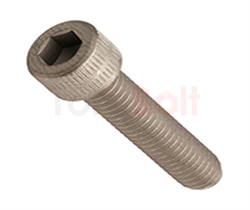
TorqBolt manufactures CRES A286 bolts for the US-spec aerospace and defence supply chain. CRES (Corrosion-Resistant Steel) is the legacy US designation that distinguishes austenitic-stainless-steel and precipitation-hardening-stainless-steel fasteners from the carbon-steel alloy bolts (typically marked PHCS or LAS). A286 falls in the CRES category: it is non-magnetic, austenitic, age-hardenable, oxidation-resistant to 982 °C, and remains corrosion-resistant in jet-engine, salt-fog and marine atmospheres. Each CRES A286 bolt is forged from A286 bar, thread-rolled, solution-treated and precipitation-aged to ASTM A453 grade 660 Class A. Lot traceability runs from VIM-VAR melt to finished bolt; AS9102 first-article inspection on every drawing/revision per AS9100D AQMS.
TorqBolt produces CRES A286 bolts in every aerospace head pattern and dimensional standard:
| Size | Pitch | Standard | Drive | Min. tensile (lbf) | Marking |
|---|---|---|---|---|---|
| #10 (5 mm) | 32 UNF | NAS 1351N3 | Hex socket | 1,800 | A286 + lot |
| 1/4 (6 mm) | 28 UNF | NAS 1351N4 | Hex socket | 3,200 | A286 + lot |
| 5/16 (8 mm) | 24 UNF | NAS 1351N5 | Hex socket | 5,300 | A286 + lot |
| 3/8 (10 mm) | 24 UNF | NAS 1351N6 | Hex socket | 8,000 | A286 + lot |
| 7/16 (11 mm) | 20 UNF | NAS 1351N7 | Hex socket | 11,000 | A286 + lot |
| 1/2 (13 mm) | 20 UNF | NAS 1351N8 | Hex socket | 14,500 | A286 + lot |
| 5/8 (16 mm) | 18 UNF | NAS 6610 | 12-point | 23,500 | A286 + lot |
| 3/4 (19 mm) | 16 UNF | NAS 6612 | 12-point | 34,000 | A286 + lot |
Every a286 cres bolts TorqBolt ships traces back to a vacuum-induction-melted plus vacuum-arc-remelted (VIM-VAR) ingot meeting AMS 5731 / 5732 chemistry. The complete process route:
Each lot ships with a signed inspection certificate. AS9100D-compliant aerospace lots include AS9102 first-article reporting on every new drawing or revision. Industrial orders default to EN 10204 type 3.1; sour-service and offshore step up to type 3.2 with third-party witness.
CRES A286 bolts torque to 75 % of room-temperature 0.2 % yield (~71 ksi residual stress on grade 660 Class A) for static aerospace joints; 60 % of yield for cycling joints. Aerospace torque values from MIL-HDBK-60 or specific airframe assembly manual; never use commercial DIN / SAE J429 tables on CRES aerospace bolts. Above 540 °C apply nickel anti-seize per AS5272 to avoid austenitic-stainless thread galling. Aerospace OEMs (Boeing, Airbus, GE, P&W) typically mandate replacement of CRES bolts after one assembly cycle for primary-structure joints, re-use only on secondary structure with documented torque history.
CRES A286 bolts are the workhorse of US-spec aerospace and defence assemblies. Major applications:
Every A286 fastener is released against the applicable industry standard. EN 10204 type 3.1 mill certificates ship with every order. See the consolidated A286 AMS / ASTM specifications hub for full spec scope.
| Authority | Specification | Coverage |
|---|---|---|
| ASTM | A453 grade 660 Cl. A/B/C/D | High-temperature bolting material |
| ASTM | A638 grade 660 Type 1/2 | Forged bolting stock |
| AMS | 5731 | Bar / forging, solution-treated |
| AMS | 5732 | Bar / forging, solution-treated and aged |
| AMS | 5737 | Bar, solution-treated and aged (precision) |
| UNS | S66286 | Material designation |
| DIN | 1.4980 / X5NiCrTiMoVB25-15-2 | European designation |
| EN | 10204 3.1 / 3.2 | Mill / third-party-witness certification |
| NACE | MR0175 / ISO 15156-3 | Sour-service hardness limit ≤ HRC 35 |
When selecting a fastener material engineers compare A286 against three alternatives: A286 vs Inconel 718 (top-end performance, 3× cost), A286 vs 17-4 PH (cheaper but limited to 315 °C), and A286 vs Waspaloy (sustained service > 700 °C). Across the 540-700 °C operating window, A286 delivers the lowest cost per MPa of retained preload. See the consolidated A286 equivalent grades reference for full alloy alternatives.
A complete a286 cres bolts callout should include: material spec, heat-treatment condition, dimensional standard, size, thread tolerance class, surface finish, marking, inspection certificate. Example callout:
NAS 1351-N6, A286 (UNS S66286), ASTM A453 grade 660 Class A, ST+A, 3/8 inch × 16 UNF, 3 inch length, MIL-S-8879 thread, magnetic permeability < 1.005, passivated, head-marked ‘A286’ + lot + ‘TB’, AS9102 first-article on lot, EN 10204 3.1 with NIST-traceable mill cert.
CRES stands for Corrosion-Resistant Steel, the legacy US aerospace term for stainless and precipitation-hardening-stainless fasteners including A286, 17-4 PH, 17-7 PH, AM-355, and 13-8 Mo. CRES designation appears on US-spec aerospace drawings (NAS, MS, MIL, BAC) to distinguish from carbon-steel PHCS or LAS bolts.
Material is identical (UNS S66286, ASTM A453 grade 660). Manufacturing differs: CRES bolts are produced under AS9100D AQMS with MIL-S-8879 Class 3 thread tolerance, AS9102 first-article inspection, and lot serialization. Commercial A286 bolts use ISO 4762 / DIN 912 commercial thread Class 2A and EN 10204 3.1 mill cert only.
Head-stamped 'A286' + lot number + manufacturer code 'TB'. Aerospace standards may add grade 'GR 660' for ASTM A453 traceability. NAS bolts add the NAS part number (NAS 1351N6) on the head. Stamp depth 0.05-0.10 mm raised or recessed per drawing.
NAS 1351 / 1352 / 6203 (socket head), NAS 6603-6620 (12-point), MS 90725 / 90726 (hex), BACB30NW / BACB30LE (Boeing), AS3239 / IFI-115 (12-point flange), MIL-S-8879 (thread tolerance), MIL-W-19140 (washers). Each cites A286 / UNS S66286 material per AMS 5732.
No. A286 austenitic FCC matrix has magnetic permeability < 1.005, verified per ASTM A342 on every aerospace lot. This is preserved through manufacture, aging, and cold work, making CRES A286 the standard for instrumentation, MRI, magnetometer, and electromagnetic-sensitive aerospace assemblies.
For service ≤ 700 °C, yes. CRES A286 is one-third the cost and meets the same temperature ceiling. For room-temperature applications requiring tensile > 1240 MPa, Inconel 718 is required. See A286 vs Inconel 718.
MIL-S-8879 / ASME B1.13M Class 3A (inch) or 4g6g (metric), tighter than commercial 2A / 6g. This is required for aerospace fatigue performance per NAS 6203 / NAS 1351 acceptance criteria.
Yes. Passivated per ASTM A967 Type II (HNO₃ + HF) post-aging to remove free iron and residual oxide. Aerospace acceptance: 96-hour salt-spray pass per ASTM B117. Passivation does not affect magnetic permeability or mechanical strength.
Aerospace primary structure (engine mount, wing spar, fuselage frame): NO, single-use only. Secondary structure with documented torque history: yes, with thread-distortion and head-stamp inspection. Industrial / commercial applications: yes, multiple cycles permitted.
Three reasons aerospace and gas-turbine OEMs place a286 cres bolts orders with us:
Over thirty years in fastener manufacture with current ISO 9001:2015, AS9100D, PED, and NORSOK M-650 quality system audits.
Active CRES A286 bolt orders span jet-engine compressor disc retention (NAS 6610-6620 12-point), aerospace accessory gearbox SHCS (NAS 1351), military airframe bolting (MS 90725 / MS 90726), and helicopter rotor-head transmission bolts (BACB30NW). All shipped with AS9102 first-article inspection and AS9100D AQMS lot serialization.